
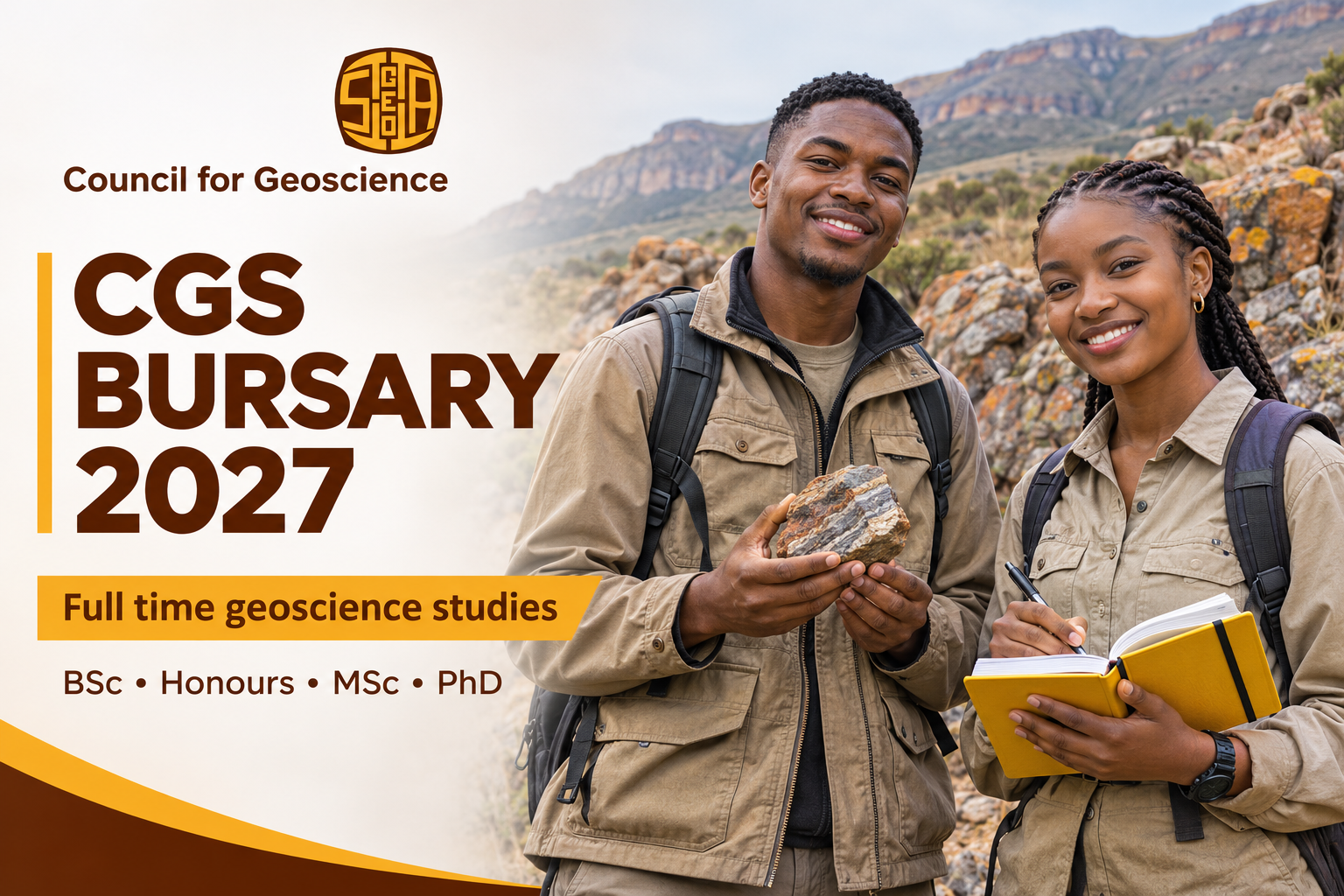
Council for Geoscience Bursary Programme 2027: Unlock Your Potential and Build a Bright Future in Geoscience
Council for Geoscience Bursary Programme 2027 Supports Your Next Step in Earth Science
Studying the Earth can lead to work that helps communities understand groundwater, mineral resources, environmental change and geological hazards. However, paying for a science qualification can be a challenge, especially when practical work and research bring additional expenses. The Council for Geoscience Bursary Programme 2027 offers funding support for qualifying South African students pursuing full time studies in geoscience and related fields. Its application form accommodates students working towards BSc, Honours, MSc and PhD qualifications. For school leavers planning their next step and university students continuing their studies, this is an opportunity worth understanding. This guide explains the academic requirements, advertised funding, work commitments and application documents so you can prepare a complete submission using the official information.
About the Council for Geoscience Bursary
The Council for Geoscience, also known as CGS, collects and maintains South Africa’s geoscience information. Its work involves using scientific knowledge to help address practical challenges on land and offshore.
The bursary programme aims to develop expertise in geoscience and related technical fields. It supports the development of students whose studies can contribute to this work.
Applicants should understand that submitting a form does not guarantee funding. The provider assesses applications, and preference is given to previously disadvantaged applicants. Other eligible candidates are also welcome to submit an application.
The programme’s requirements and funding categories are published on the official Council for Geoscience bursary page.
Which Qualifications and Fields Are Included?
The official application form lists the following qualification types:
- Bachelor of Science, or BSc
- BSc Honours
- Master of Science, or MSc
- Doctor of Philosophy, or PhD
Applicants must study full time at a South African higher education institution for the 2027 academic year.
The provider encourages several areas of study and research, including:
- Engineering geology and geotechnical investigations
- Geophysics
- Hydrogeology, particularly groundwater modelling
- Geochemistry
- Economic geology and mineral economics
- Data science and innovation studies
- Geo-informatics, GIS and remote sensing
- Computational geosciences
- Seismology and geohazards
- Science communication
- Analytical chemistry
- Environmental science and geology
- Geochronology and palaeontology
- Geohydrology
- Marine geology
- Exploration geology
Other related disciplines may be considered. If your qualification has a different title, explain its connection to geoscience clearly. Do not assume that every science or technology qualification automatically qualifies.
Who Can Apply?
To meet the published eligibility requirements, applicants must:
- Be South African citizens.
- Be unemployed.
- Be enrolled for full time study at a South African higher education institution in 2027.
- Be available for vacation work during their studies when required.
- Be available to work back after completing their studies when required.
- Have passed all modules in the previous year or semester if already studying at a higher education institution.
The form includes sections for school leavers and existing university students. Applicants should complete the sections relevant to their circumstances and provide admission evidence.
The public call does not state a minimum percentage average. Continuing students should nevertheless pay particular attention to the requirement to have passed all modules in the relevant previous study period.
What Does the Bursary Cover?
The advertised funding categories include:
- Registration and tuition fees
- An accommodation or transport allowance
- An allowance for prescribed books
- A meals allowance
- A personal protective equipment allowance
- Field excursions and analysis
- A once-off laptop allowance for first-time bursars
These categories can support both classroom learning and the practical demands of geoscience studies.
However, the public call does not specify payment amounts, allowance caps or payment schedules. Applicants should not assume that every personal expense will be covered.
Successful candidates should read their award documents carefully and confirm how accommodation or transport support will work, which costs require approval and whether any expenses must be supported by receipts.
Understand the Work Commitments
The bursary includes a requirement to be available for vacation work during your studies and work back after completing your qualification, when required.
These commitments deserve careful attention before accepting an award. The public call does not specify the length of the work back period or explain every contractual condition.
Ask for clarity about the work arrangements, location and duration when reviewing an offer. Availability for work back should not be described as a guarantee of permanent employment.
The application form also asks about other bursaries you have applied for or received. Answer this section accurately and attach the relevant bursary contract where requested.
Documents You Need to Prepare
The official call requests the following supporting documents:
- A motivation letter
- An updated CV
- A certified copy of your South African ID
- Your latest academic record
- Certified Grade 12 results, or Grade 11 results together with Grade 12 Term 3 results
- An acceptance or admission letter from your higher education institution
The form also refers to provisional admission evidence and academic transcripts for continuing students.
Check that your documents are readable, complete and consistent. Your name, qualification details and contact information should match across the form and supporting records.
How to Submit Your Application
- Download the official CGS bursary application form for 2027.
- Complete the relevant sections without changing the form’s structure.
- Sign the declaration and include the date.
- Attach all required supporting documents.
- Email your application to bursaries@geoscience.org.za.
- Include BursaryFT-2027 in the email subject line.
Applications close on 25 November 2026. Late or incomplete submissions can be disqualified.
For questions, the provider lists bursaryenquiries@geoscience.org.za. This address is for enquiries only. Applications must go to the separate bursary application address above.
Application Tips for a Stronger Submission
Make your motivation specific. Explain why you chose your field and how you hope to contribute. A clear interest in groundwater, geological mapping, environmental research or another relevant area is more useful than a general statement about wanting funding.
Use evidence from your studies. Mention relevant coursework, projects, practical experience or research interests. Describe your own contribution honestly.
Explain your research direction. Honours, MSc and PhD applicants should complete the research topic section clearly and show how their proposed work connects to the programme.
Keep your CV focused. Include your education, relevant skills, projects and experience. A student CV does not need a long employment history to communicate potential.
Check the complete email before sending. Confirm the recipient, subject line, signed form and attachments. Keep a copy of the submission for your records.
What Happens After Applying?
The provider states that correspondence will be limited to successful applicants. The application form also advises applicants to regard their submission as unsuccessful if they have not been contacted within one month after the closing date.
Keep your phone number and email address active, and respond promptly if further information is requested. A complete application gives the provider the information it needs to assess you, while an award remains subject to selection.